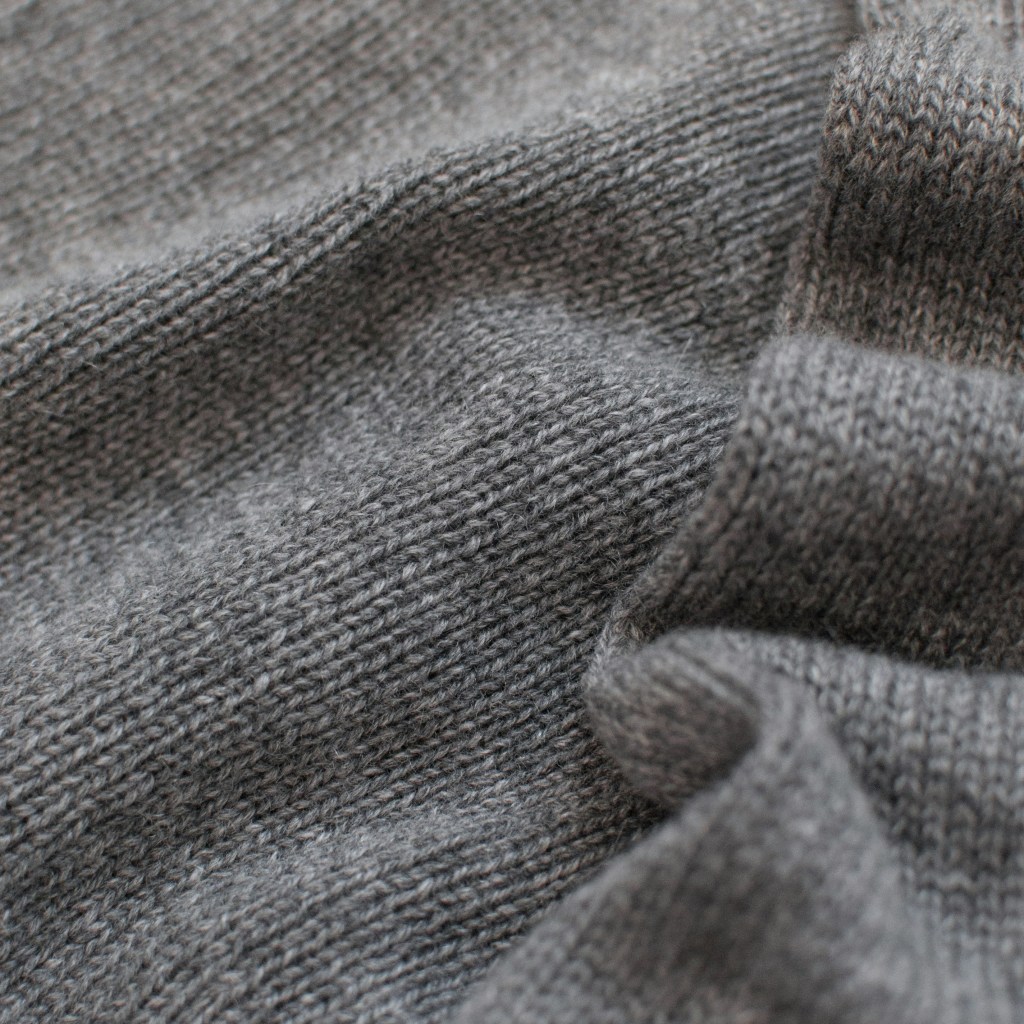
Every thrift store has a rack where the sweaters look expensive and the tags are lying. Real cashmere is one of the best bargains in resale, and one of the easiest things to get wrong, because “cashmere” on a label, a hang tag or a price sticker doesn’t prove much. Here are three checks that take under a minute each, plus what to grab and what to leave on the rack. Skip the burn test. Store staff frown on lighters.
A note up front: nothing here is a lab test. Together, though, these checks will keep you from carrying a $4 acrylic cardigan to the register with a straight face.
Check 1: Squeeze it, then hold it to the light
The fist test. Grab a handful and squeeze it hard for about ten seconds, then let go. Real cashmere relaxes and springs back with soft, shallow creases that fall out in a minute. Acrylic and rayon blends either stay creased or flop back with no life in them.
The halo test. Hold the sweater up to a window or a bright fixture. Cashmere has a soft, hazy halo of tiny fibers around the surface, like the fuzz on a peach. Synthetics look flat and slightly shiny, with crisp edges around each stitch.
The cheek test. The skin on your cheek or inner forearm is more sensitive than your fingertips, so press the fabric there. Good cashmere feels dense and silky. Scratchy means coarse wool, and slippery-soft with no body usually means acrylic that has been chemically softened.
Check 2: Turn it inside out
Read the seams. Look at the armholes and shoulders. Little stair-step marks where the stitches narrow are the sign of a fully fashioned piece, knit to shape instead of cut from fabric and sewn. Better cashmere is often made this way. Raw, serged edges are a sign of cheaper cut-and-sew construction.

Study the pilling. Cashmere does pill, because its fibers are short. Those pills are soft and rub off with a fingertip. Hard, tight little beads that cling to the knit usually mean synthetic fibers. A sweater pilled evenly everywhere is a worse sign than one pilled only where your arms rub.
Hunt for moths. Hold the inside up to the light and look at the underarms, the ribbing and the folds. Tiny, clustered holes, thin patches or fine webbing all mean moth damage. A mothball smell means someone has already been fighting them. Walk away, since the damage rarely stays contained to one spot.
Check the gauge. Thin, fine knits that feel airy are usually the better buy. Chunky knits can be lovely too, but they hide a lot, so give them an extra close look for felting and stretching.
Check 3: Read the label like a skeptic
Read the order. Fibers are listed from most to least. “70% wool, 30% cashmere” is a wool sweater with a cashmere garnish, so price it that way. A solid cashmere piece lists cashmere first, or alone.
Treat marketing words as noise. “Cashmere feel,” “cashmere touch” and “cashmere-like” are descriptions of how it was made to feel. They are not a fiber content. If the label never names cashmere, don’t pay cashmere money.
Look for what’s missing. A cut-out label isn’t proof of anything, since people snip scratchy tags. But a sweater with no label and no brand needs to pass all of Checks 1 and 2, and the price should reflect the gamble.
Check the care tag. Hand wash or dry clean only is what you’d expect from real cashmere. A machine-washable tag isn’t automatically a bad sign, since some makers treat the yarn. But “tumble dry low” on something sold as luxury is a reason to look harder.
Watch the word “recycled.” Recycled cashmere is made of shorter fibers, so it’s softer at first and wears out faster. It can still be a fine buy at thrift prices, as long as you aren’t paying for the real thing.
What to grab, what to skip, and how to keep it
Grab
- Men’s sweaters. They’re often cut larger and priced lower, and a boxy fit looks deliberate on anyone.
- Cardigans and vests. They hide less wear than pullovers do, and they layer.
- Anything fine-gauge in a dark color. Dark knits hide small stains and fading better.
Skip
- Felted patches, which are stiff, matted areas from a hot wash. They can’t be undone.
- Stretched necklines and cuffs that no longer snap back.
- Yellowed underarms and anything with that stored-in-a-basement smell.
Care
- Wash by hand in cool water with a gentle wool wash or baby shampoo. Press the water out in a towel and never wring it.
- Dry it flat and reshape it while it’s damp.
- Take pills off with a sweater comb or a fabric shaver, lightly.
- Freeze a new find in a sealed bag for a few days before it goes in your closet, just in case it came with moths.
My own rule from years of estate sales: touch it before you read the tag. The sweaters that earn their price pass the squeeze test whether or not the label says anything, and the ones that disappoint tend to be wearing the most confident hang tag in the room. Let your hands do the first round and let the label confirm it.
Where to hunt next
Cashmere tends to turn up at estate sales and in the better thrift neighborhoods, usually in a closet-clearing donation. If you’re shopping for gifts, our Anti-Black Friday Gift Guide has ten more ideas that beat the doorbusters, and a guide to estate sale shopping is coming soon.


Leave a Reply